ExplainedApril 11, 20268 min read

Protected vs Unprotected Electricity Tariff in Pakistan — What You Need to Know

Protected vs Unprotected Electricity Tariff in Pakistan — What You Need to Know

The single biggest variable in a Pakistani residential electricity bill — more impactful than FPA, more significant than seasonal usage changes — is whether your connection is classified as protected or unprotected. The difference in per-unit rates between the two categories is substantial. And the rules that determine which category you fall into catch a lot of people by surprise.

What is the Protected Electricity Tariff?

The protected tariff (officially A-1 Residential Protected) is a subsidised rate structure for low-consumption households. To qualify as a protected consumer, your connection must meet all three conditions simultaneously:

  1. Monthly consumption of 200 units or fewer — measured every billing month individually
  2. No air conditioner registered on the meter — any AC listed under your meter's sanctioned load disqualifies you, regardless of whether you actually use it
  3. Sanctioned load under 5kW — the maximum approved load on your connection must be below 5 kilowatts

Protected consumers pay significantly lower per-unit rates than unprotected consumers. The exact rates are set by NEPRA and revised periodically — always check the NEPRA tariff schedule or your DISCO's official tariff page for current figures.

What is the Unprotected Tariff?

The unprotected tariff (A-1 Residential Unprotected) applies to everyone who does not meet all three protected conditions. If your consumption crosses 200 units in any month, if an air conditioner is registered on your meter, or if your sanctioned load exceeds 5kW, you are billed at unprotected rates for that billing period.

Unprotected per-unit rates are considerably higher and follow a progressive slab structure: the more units you consume, the higher the per-unit rate — applied not just to the excess units, but to your entire consumption for that month.

The 200-Unit Threshold — How It Actually Works

This is where most people are caught off guard.

The protected/unprotected classification for any given month is determined fresh each billing cycle — it is not based on your average usage or your history with that status. If you normally consume 180 units and your consumption crosses 200 units in a single month — perhaps during a hot week in June or when guests stay over Eid — the entire month's bill is calculated at unprotected rates.

Not just the units above 200. Every single unit you consumed that month is billed at the higher unprotected rate.

To illustrate why this matters: suppose the protected rate for the 101–200 unit band is significantly lower than the unprotected rate for the same band. If you consumed 210 units, you are not paying protected rates on the first 200 and unprotected rates on the extra 10. You are paying unprotected rates on all 210 units. The jump is not proportional to the extra 10 units — it affects your entire bill.

The following month, if your consumption drops back below 200 units with no AC registered and sanctioned load under 5kW, you are reclassified as protected again. The tariff type is re-evaluated every billing cycle.

This is why households consistently hovering around 190–200 units are the most exposed to unexpected bill spikes from a single high-usage month.

The Air Conditioner Rule — The Permanent Disqualifier

This is the rule that surprises people most.

If any air conditioner is formally registered under your meter's sanctioned load, your connection is classified as unprotected — permanently, for every month, regardless of your actual consumption.

It does not matter whether you use the AC. It does not matter if you physically removed it. What matters is whether it is listed on your meter's official record with your DISCO. Even in January, even in a month where you consumed 80 units, if an AC is on record, you are unprotected.

The implications are significant. A family that installs a split AC in summer and formally registers it with their DISCO for the required load revision is from that point forward an unprotected consumer — even during the eight months of the year when the AC is never switched on.

Removing the AC from the official record requires a formal load revision application with your DISCO — not just physically disconnecting the unit. The process involves an inspection and paperwork, and not all sub-divisional offices process it quickly.

The 5kW Sanctioned Load Rule

If your sanctioned load is above 5kW, you are typically on a three-phase connection. Three-phase consumers are billed under the Time of Use (TOU) tariff rather than the standard residential slab structure. TOU billing involves peak and off-peak rates tied to specific hours of the day.

For most single-phase households, sanctioned load stays under 5kW and this condition rarely triggers unprotected status on its own. It becomes relevant mainly for larger properties with multiple high-draw appliances or industrial equipment registered on the same meter.

How to Check Whether You Are Protected or Unprotected

The fastest way is to look at the Tariff Type field on your electricity bill. On any DISCO's duplicate bill:

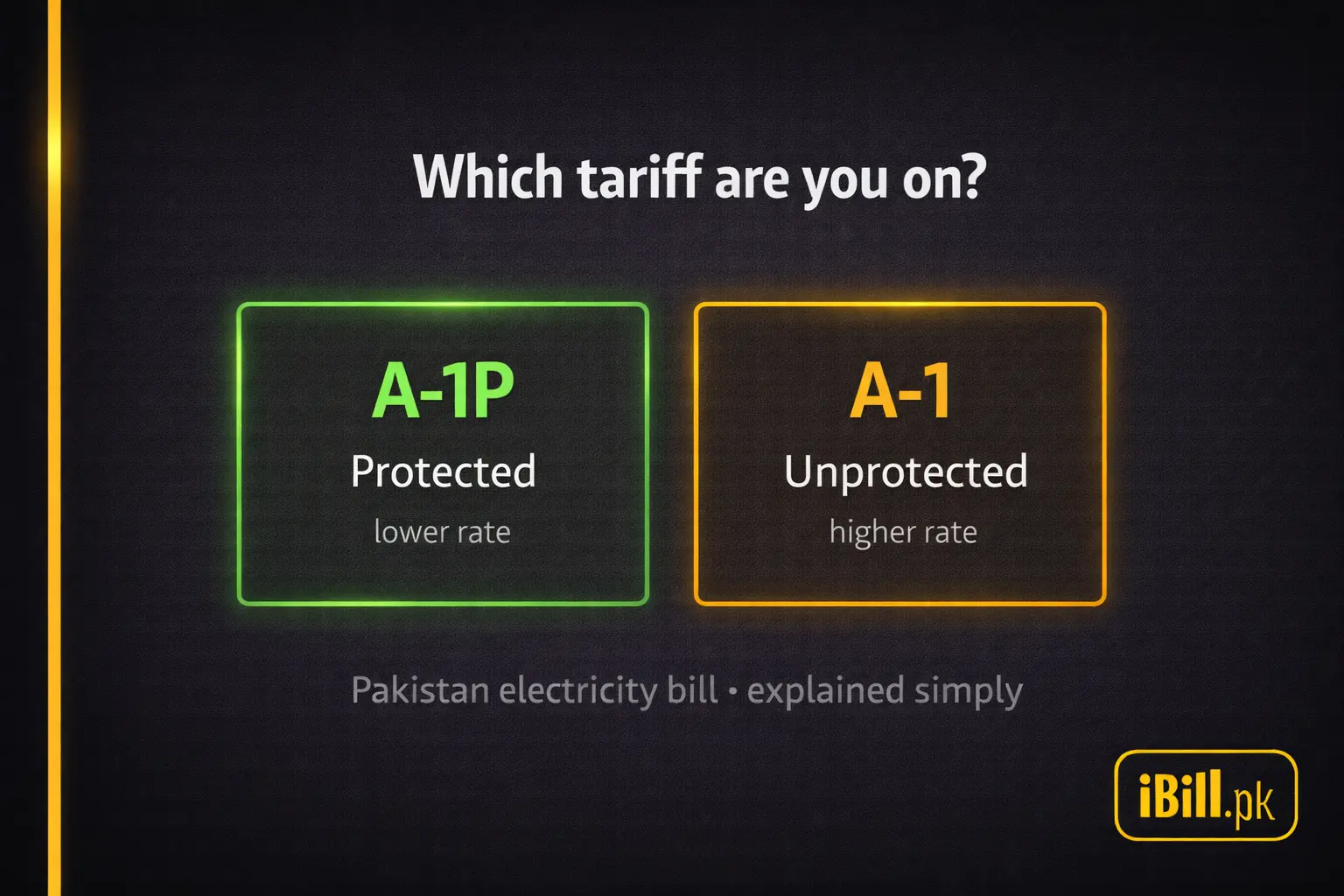
  • A-1(P) or A-1P = Residential Protected
  • A-1 = Residential Unprotected (the absence of the P suffix indicates unprotected status)

This field is in the consumer details section at the top of the bill — the same section that shows your name, Reference Number, and meter information. You can check it on the duplicate bill online through iBill.pk.

The same A-1 / A-1P notation is used across all XW-DISCOs — LESCO, MEPCO, IESCO, FESCO, GEPCO, and the rest all use this designation system.

When DISCOs Manipulate the Classification

Understanding the rules matters — but so does knowing that not every reclassification is a fair application of them.

A NEPRA inquiry into excessive billing found that distribution companies were manipulating billing cycles beyond the mandated 30-day period specifically to push consumers from protected to unprotected status. By stretching a billing cycle to 35 or 40 days, a consumer whose actual monthly consumption was below 200 units would appear to have crossed the threshold in the inflated period. Arab News reported that approximately 13 million consumers were overcharged through this mechanism across Pakistan.

This is not a fringe allegation — it comes from NEPRA's own investigative findings. The practical implication: if you are consistently below 200 units but your bill suddenly shows you as unprotected, check the billing period dates on your bill. If the period covered is significantly longer than 30 days, that is the likely cause and grounds for a formal dispute.

If you believe your tariff classification is wrong, file a complaint through NEPRA's consumer complaint portal or the Ministry of Energy complaint system in addition to contacting your DISCO directly. Regulatory-level complaints carry more weight than helpline calls.

How to Qualify for the Protected Tariff

Keep monthly consumption at or below 200 units. This is the primary lever. Review your billing history (the last 6 months are printed at the bottom of your duplicate bill) to understand your seasonal pattern. If you consistently use 180–210 units, targeted reductions in your peak months can keep you in the protected band. For practical steps, see How to Reduce Your Electricity Bill in Pakistan.

Ensure no AC is registered on your meter. If you added an AC connection and want to return to protected status, you need to submit a load revision application to your DISCO and have the AC formally removed from your sanctioned load record. In practice this process is slow — it requires an inspection visit and sub-divisional offices are frequently backlogged. Follow up in person, keep records of every visit, and do not assume the application is progressing without confirmation.

Avoid sanctioned load above 5kW. This typically only happens when you formally request a higher load for construction, a new AC installation, or industrial equipment.

Practical Example

An IESCO consumer in Islamabad with a single-phase connection. Monthly consumption averages 160–180 units across the year. No AC registered. Sanctioned load 2kW. In June and July, when fans, a portable cooler, and more frequent appliance use push consumption to 210–220 units, those two months are billed at unprotected rates. Every unit for those months — not just the 10–20 above 200 — at the higher per-unit rates.

The fix: reviewing whether adjusting the water pump schedule, shifting laundry to cooler hours, or reducing other loads in June and July can bring those months back under 200 units. It is often closer than it looks once you identify the specific load that is pushing you over.

Frequently Asked Questions

What is the difference between A-1 and A-1P on my electricity bill?
A-1P (or A-1 Protected) means your connection is on the protected residential tariff — a lower per-unit rate for households using 200 units or fewer per month with no registered AC and sanctioned load under 5kW. A-1 without the P suffix means you are on the unprotected tariff with higher per-unit rates.

If I cross 200 units in one month, does my whole year become unprotected?
No. The classification is re-evaluated every billing month. If you cross 200 units in a single month, only that month's bill is at unprotected rates. The following month, if you drop back below 200 units and still have no AC registered and load under 5kW, you are reclassified as protected again.

Does having an AC permanently disqualify me from the protected tariff?
Yes — if the AC is formally registered on your meter's sanctioned load. The registration, not the actual usage, determines the tariff category. Removing the AC from the load record requires a formal application and inspection with your DISCO.

Why does crossing 200 units affect my entire bill and not just the units above 200?
Pakistan's protected tariff is a categorical classification, not a marginal rate. When your consumption crosses 200 units, your tariff category for that entire month switches from protected to unprotected — and unprotected billing recalculates from unit 1, not from unit 201. This is a fundamental feature of the tariff structure, not a billing error.

Can I have one protected and one unprotected connection for the same address?
Each meter connection is assessed independently. If you have two separate meters at the same property, each one's tariff type depends on its own consumption and registered load.

How do I know what my sanctioned load is?
Your sanctioned load is listed in the consumer details section at the top of your electricity bill. It is expressed in kilowatts (kW) and represents the maximum load your connection is approved for.

IK
Idrees Khan
Electricity & Energy Contributor
Idrees has spent over 25 years as a WAPDA consumer — 15 years on LESCO in Lahore and now on IESCO in Islamabad. He uses solar panels with a hybrid inverter and helps communities in northern Pakistan install solar systems.
[email protected]

Related Tools