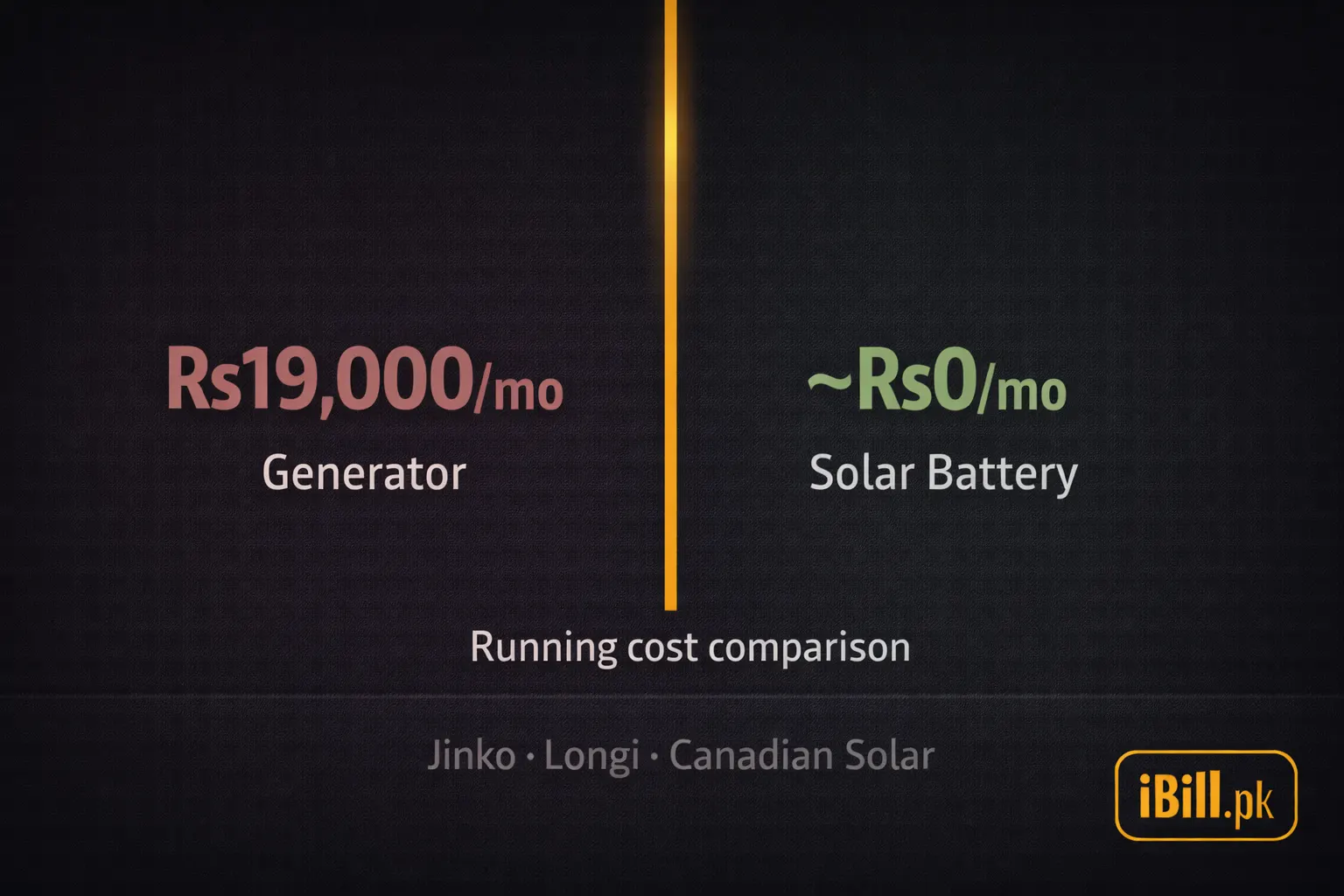
Two households in the same neighbourhood. Both face the same 2.25 hours of daily load shedding under Pakistan's April 2026 Peak Relief Strategy. One runs a petrol generator every evening. The other has a hybrid solar inverter with a battery bank that kicks in automatically when power cuts. After two years, their cumulative costs are not even close.
The generator wins on upfront cost. Everything else favours the solar battery system. Here is the full comparison.
What Does a Generator Actually Cost to Run?
This is where generator economics break down for most households, because the purchase price is only the beginning.
Petrol in Pakistan currently costs approximately Rs366 per litre (April 2026 rate set by OGRA — prices change fortnightly and reached Rs458/litre as recently as early April 2026). A small 1–2kW residential generator consumes roughly 0.6–0.9 litres per hour at moderate load.
Running a 1kW generator for 2.5 hours daily:
| Calculation | Monthly cost | |
|---|---|---|
| Fuel | 0.7 litres/hr × 2.5 hrs × 30 days × Rs366 | ~Rs19,300 |
| Engine oil changes | Every 50–100 hours (~monthly) | Rs1,500–3,000 |
| Maintenance, spark plugs | Averaged monthly | Rs500–1,000 |
| Total running cost | ~Rs21,000–24,000/month |
That is the monthly cost for 2.5 hours of generator use per day — barely covering the scheduled outage window. If unannounced outages extend the runtime, costs rise proportionally.
Over 12 months: Rs250,000–290,000 in running costs alone for a modest 1kW unit. Over two years, you have spent more on fuel than a decent solar battery system costs to buy.
What Does a Solar + Battery System Cost to Run?
After the upfront installation, a solar battery system's monthly running cost is effectively zero for the backup function.
The battery charges during daylight hours from solar panels. When grid power cuts in the evening, the inverter switches to battery automatically — silently, instantly, without starting an engine. No fuel. No oil changes. No trips to the petrol pump.
The only ongoing costs are:
- Battery replacement: Lithium (LiFePO4) batteries last 8–12 years at typical cycling rates. Tubular lead-acid batteries last 3–5 years and cost Rs30,000–80,000 to replace.
- Inverter maintenance: Minimal — inverters are solid-state with no moving parts. NEECA provides guidance on sizing solar systems and inverters for residential use.
Monthly running cost for backup function: Rs0 in fuel, Rs500–1,000 averaged for long-term battery replacement provision.
Upfront Costs Compared
| Solution | Upfront cost (approx.) |
|---|---|
| 1–2kW petrol generator | Rs72,000–150,000 |
| Basic UPS (1kW) + lead-acid battery | Rs90,000–130,000 |
| Hybrid solar inverter (3–5kW) + battery, no panels | Rs200,000–400,000 |
| Full hybrid solar system (5kW) with panels + battery | Rs800,000–1,200,000 |
The generator wins on purchase price. A basic UPS with a lead-acid battery bank is competitive and covers lights and fans. The full hybrid solar system is the most expensive upfront but replaces both the backup solution and substantially reduces your monthly electricity bill — making the comparison against a generator increasingly one-sided over 3–5 years.
For context: at Rs22,000/month in generator running costs, a Rs900,000 hybrid solar system pays for itself in roughly 3.5 years purely from eliminated fuel costs — before accounting for any reduction in your WAPDA electricity bill.
Noise, Fumes, and Practical Realities
This dimension matters more than most cost comparisons acknowledge.
Pakistan imported 12.7 GW of solar panels in the first nine months of FY2025 alone — a sign of how rapidly households are moving toward solar backup over generators. The economics below explain why.
Generator drawbacks in a residential setting:
- Audible from 50–100 metres — problematic in dense housing colonies and apartment buildings
- Petrol fumes require outdoor placement or significant ventilation
- Starting the engine manually every evening is a chore; automatic start requires additional investment
- Fuel storage on premises is a fire hazard
- Cannot be run at night in many residential areas without disturbing neighbours
Solar battery advantages:
- Completely silent — the inverter switches automatically, you may not notice the power cut
- No fumes, no emissions, no storage hazard
- Works inside apartments and flats with no modification
- Switches back to grid automatically when power returns
- No human intervention required
For families with infants, elderly members, or anyone working from home during load shedding hours, the quality-of-life difference between a generator and a silent battery backup is substantial.
What Each Solution Can Power
A 1kW generator or a 1kW UPS/battery system covers the same basic loads:
- LED lights, ceiling fans, phone chargers, a router — fully covered
- A desktop computer or television — covered
- A 1.5-tonne split AC — not covered on a 1kW system
To run an air conditioner during load shedding, you need at minimum a 2–3kW generator or a hybrid solar inverter sized for AC load (typically 3–5kW). Generator: Rs150,000–250,000 upfront plus higher fuel consumption (~1.5–2.5 litres/hour under AC load). Hybrid inverter with sufficient battery: Rs250,000–500,000 upfront for inverter and battery alone, more with panels.
For most households, the practical decision is:
- Lights, fans, router: Basic UPS or modest battery system, Rs90,000–130,000 once
- Lights, fans, router, plus work devices: 3kW hybrid inverter + battery, Rs200,000–350,000
- Full household including AC: Hybrid solar system with panels, Rs800,000–1,500,000
Which Makes More Sense for Your Situation?
Choose a generator if:
- You need backup immediately with minimal upfront spend
- Outages are infrequent and unpredictable — you do not want capital tied up in a battery system for occasional use
- You rent and cannot install a permanent system
- You need to power very high loads (industrial equipment, heavy machinery) that battery systems cannot match
Choose solar + battery if:
- Outages are regular and scheduled — as they are under the current April 2026 load shedding plan affecting LESCO, MEPCO, IESCO, FESCO, GEPCO, and PESCO consumers
- You own your property and can install panels
- You want to simultaneously reduce your electricity bill — the solar component generates electricity during the day whether or not there is load shedding
- Noise is a constraint — flat, apartment, or dense colony
The current load shedding schedule (5pm–1am peak window, ~2.5 hours actual cuts) maps almost exactly onto what a modest battery system handles well: a fully charged battery from daytime solar covers 2–3 hours of fans, lights, and router without any grid power at all.
For anyone considering solar and weighing costs, see Solar Panel Prices in Pakistan 2026 for current system pricing, and Net Metering vs Net Billing for how the changed export rules affect investment calculations.
Frequently Asked Questions
Is a generator or solar battery better for load shedding in Pakistan?
For regular scheduled load shedding, a solar battery system is significantly cheaper over 2–3 years despite higher upfront cost — monthly fuel costs for a generator average Rs20,000–25,000, while a battery system has near-zero running costs. For infrequent or unpredictable outages, a generator's lower purchase price makes more sense.
How much does it cost to run a petrol generator in Pakistan per month?
At current petrol prices of around Rs366 per litre (April 2026), running a 1kW generator for 2.5 hours daily costs approximately Rs19,000–24,000 per month in fuel and basic maintenance. Larger generators or longer runtimes increase this proportionally.
What size generator do I need for fans and lights during load shedding?
A 1kW generator covers ceiling fans, LED lights, a router, and phone chargers. For a television or desktop computer add a small buffer — a 1.5kW unit is comfortable. To run a 1-tonne split AC you need at minimum a 2.5–3kW generator.
Can a UPS run an air conditioner during load shedding?
Standard UPS systems cannot run split ACs — the startup current draw exceeds what most residential UPS units handle. You need a hybrid solar inverter rated for the AC's load (minimum 3kW for a 1-tonne unit, 5kW+ for a 1.5-tonne) with sufficient battery capacity. This is a more expensive system but eliminates fuel costs entirely.
How long does a solar battery last before needing replacement?
Lithium (LiFePO4) batteries typically last 8–12 years at daily cycling depths common in Pakistan. Tubular lead-acid batteries last 3–5 years. The battery replacement cost should be factored into total system economics alongside the upfront price.
Is it worth installing solar just for load shedding backup?
Rarely — the economics are better when the solar system also reduces your daily electricity bill, not just provides backup. A hybrid system that generates electricity during the day reduces your WAPDA consumption and bill, and the same battery provides backup at night. Sizing the system purely for backup without daytime generation benefit makes the payback period much longer.